Section 1 · Deep learning project
Industrial surface defect detection
From run-length-encoded labels to a tuned U-Net that scores 0.6486 on a held-out set.
The task
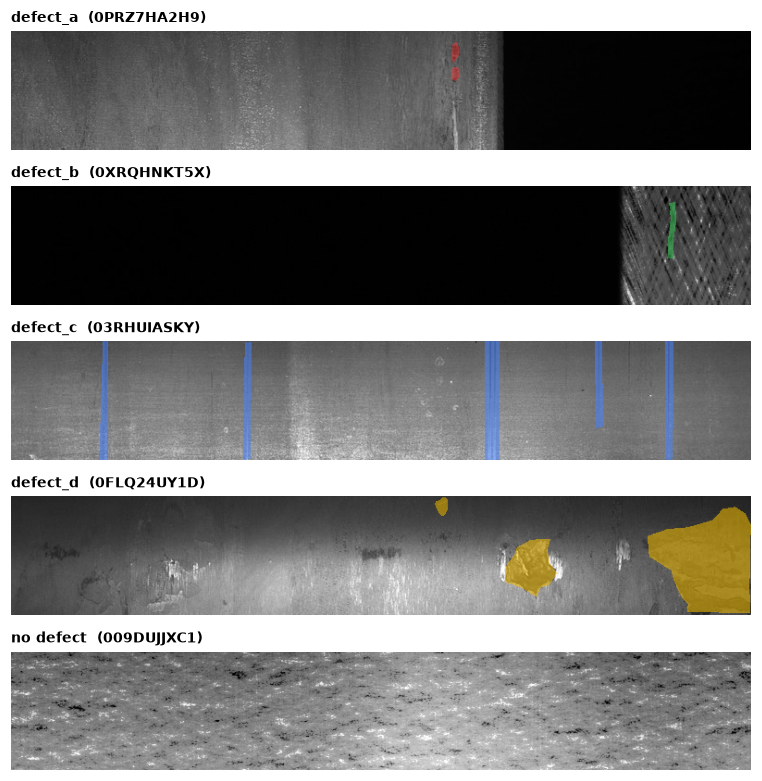
- 11,393 training images, 3,000 test images
- Each image is 800 × 128 pixels
- Four defect types,
defect_atodefect_d - Predict one binary mask per type
Labels are run-length encoded
mask_rle = "7255 6 7377 12 7505 12 ..."
# start (1-based), length, start, length ...
# pixels are numbered column by column- Pixel 129 is the top of the second column
- Empty string means the defect is absent
- The submission uses the same format, with a single space for empty
The data is mostly empty
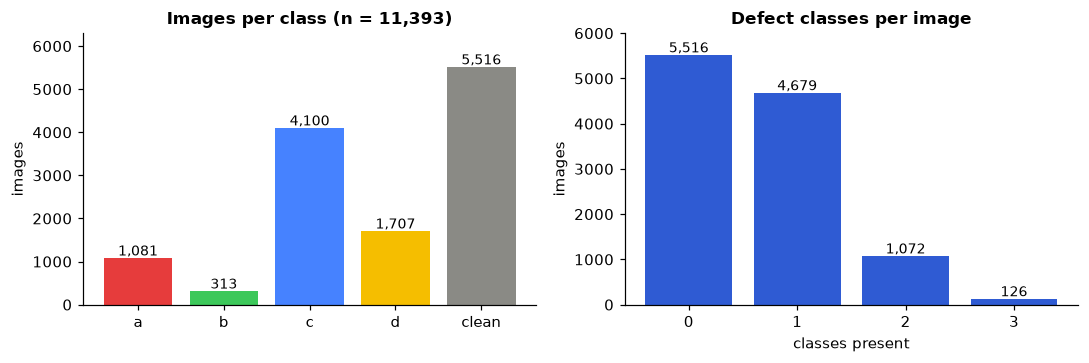
- 5,516 clean images
defect_c4,100,defect_d1,707,defect_a1,081,defect_b313- 84.2% of image-class pairs are empty
- Split 80/20, stratified on 15 label combinations
Masks are small
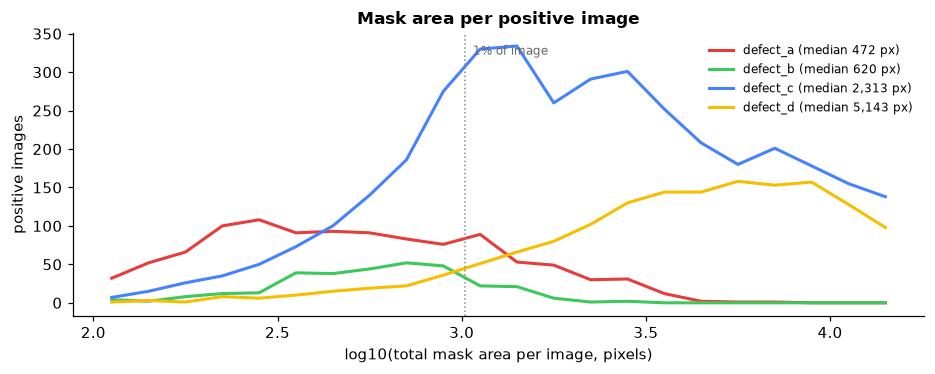
- Median component: 239 px for
defect_a, 2,696 px fordefect_d - A 200-pixel filter would delete 15.2% of
defect_amask pixels
The score
Score = 0.70 × ForegroundDice + 0.20 × FalsePositiveScore + 0.10 × EmptyAccuracy
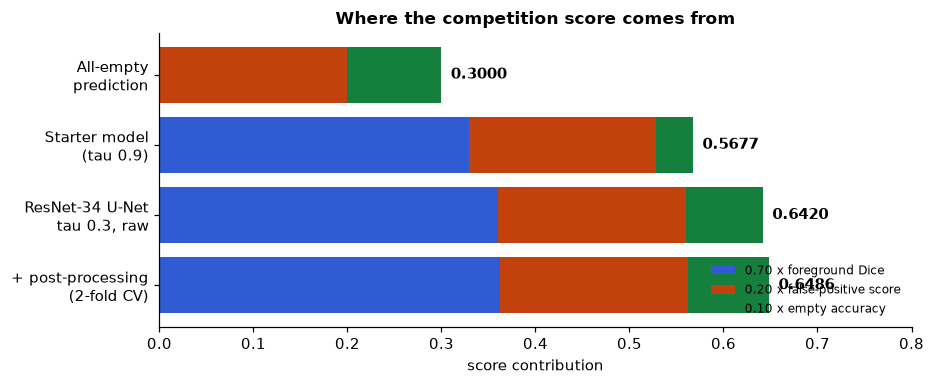
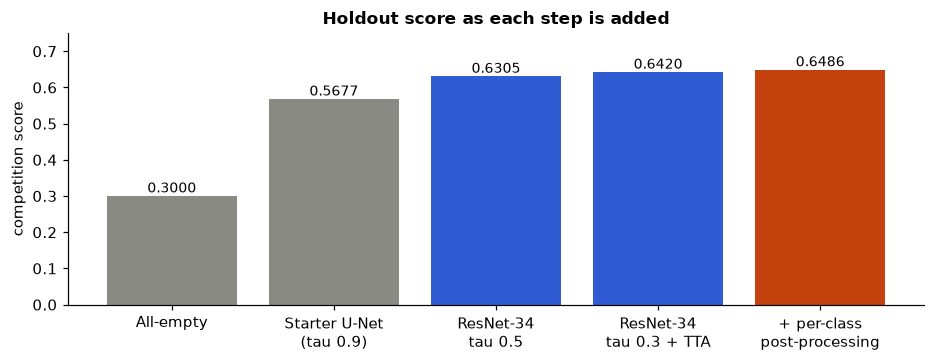
Predict nothing and you score 0.30
The metric rewards recall
9.7e-5one positive pair, 0.7 / 7,201
2.6e-6one empty pair wrong, 0.1 / 38,371
~37×ratio
- Predict a mask when the chance of a defect is above about 5%
- Naive mean Dice pushes the other way: all-empty gets 0.8420
Model: a U-Net
segmentation_models_pytorchU-Net, ResNet-34 encoder, ImageNet weights- Native 128 × 800 input: both sizes divide by 32
- Four output channels with a sigmoid each, because classes co-occur
- Skip connections keep thin edges sharp
- EfficientNet-B3 tried as a second encoder
cls(encoder_name="resnet34", encoder_weights="imagenet", classes=4)Training recipe
- Loss: BCE + multilabel Dice
- AdamW, learning rate 3e-4, weight decay 1e-4
- One-cycle schedule, 10 epochs, batch size 16
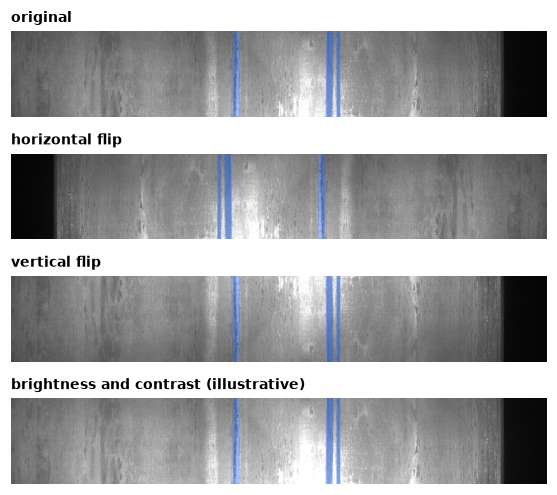
- Augmentation: flips, brightness and contrast, small shift and scale
- About 3.7 minutes per epoch on an Apple-silicon GPU
Training curves
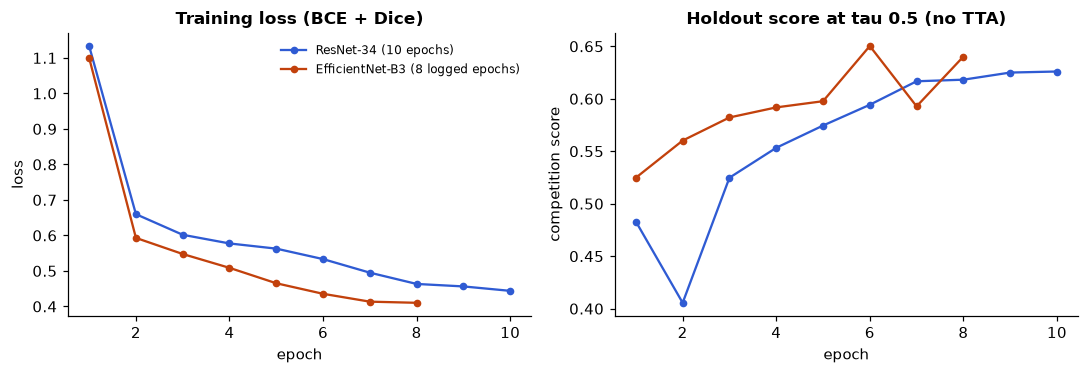
- Loss 1.13 to 0.44 in 10 epochs
- Epoch 2 dips, then the score climbs to 0.6284 at tau 0.3
- EfficientNet-B3 is noisy: 0.6503 at epoch 6, 0.5928 at epoch 7
Training in 6 seconds
One global threshold
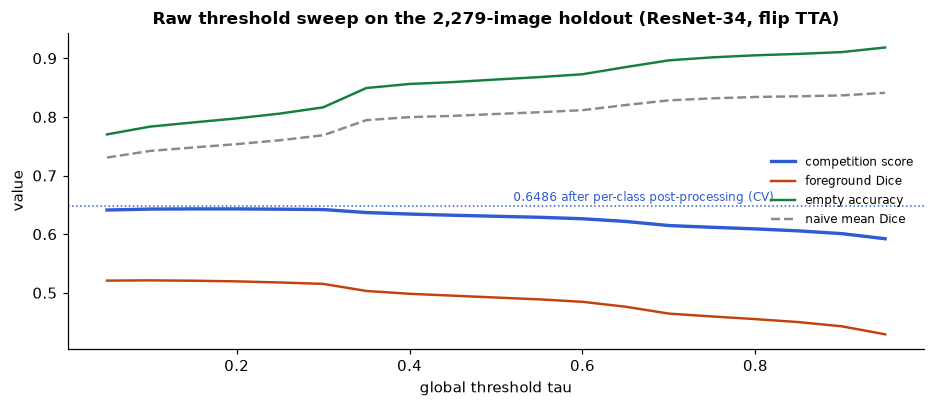
- Best raw score 0.6431 at tau 0.15 to 0.2
- Naive Dice keeps rising with tau. The official score falls.
Per-class post-processing
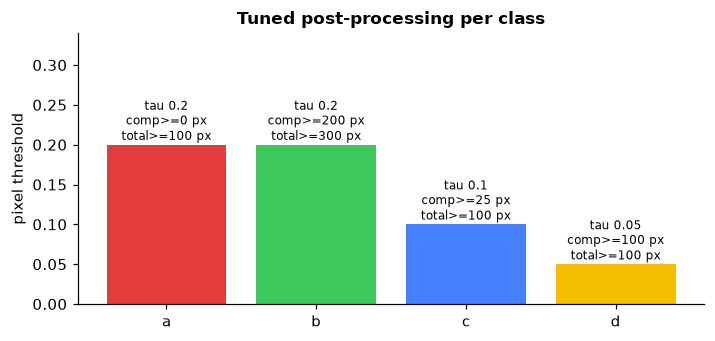
- Three rules per class: threshold, component filter, total-area filter
- Grid search, 336 combinations per class
- Validated by 2-fold CV
- 0.6420 to 0.6486
Threshold sweep, on real images
Inference and submission
- Three views per model: none, horizontal flip, vertical flip
- TTA lifts the score at tau 0.3 from 0.6284 to 0.6420
- Average the probabilities across models, apply the tuned rules, RLE-encode
- 12,000 rows: 3,000 images × 4 classes
uv run python src/predict.py r34_full effb3_full --params runs/ens/postproc.jsonLessons learned
- Read the metric first. Predicting nothing scores 0.30.
- Stratify on label combinations; tune per class; validate the tuning
- Not shown: a measured ensemble, the
r34_posresult, multiple seeds