Section 1 · Lesson 1
The problem and the dataset
You get 11,393 long, thin photos of a surface and four defect types. For each photo and each type, you predict which pixels are defective.
- What the task asks for and why it is a segmentation problem.
- How
train.csvstores one mask per image and defect type. - How run-length encoding (RLE) packs a mask into a string, and how to decode it.
The task
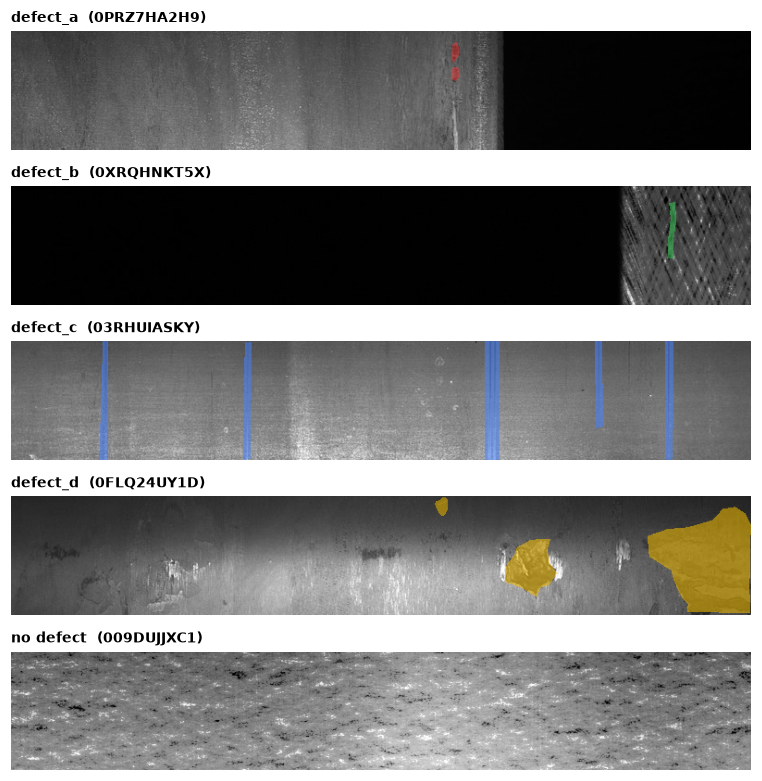
The project is a Kaggle-style course competition called "industrial surface defect detection". Each image is an 800 by 128 pixel picture of a manufactured surface. Four kinds of defect can appear, named defect_a to defect_d. An image can have none of them, one, or several.
You don't predict a label for the whole image. You predict a mask for each of the four types: a binary image the same size as the photo, where 1 means "this pixel is part of the defect". That task is called semantic segmentation.
What is in the data
The images are grayscale but stored as 3-channel JPEG files. The labels live in data/public/train.csv, with one row per image and defect type:
| Column | Meaning |
|---|---|
image_id | File name without the .jpg extension. |
defect_type | One of defect_a, defect_b, defect_c, defect_d. |
mask_rle | The mask as an RLE string. Empty when the image doesn't have that defect. |
width, height | Always 800 and 128. |
Because every image has four rows, the code reshapes the table once so that each image has one row and four mask columns. This function is in src/common.py:
def load_train_wide():
    df = pd.read_csv(DATA / "train.csv")
    wide = df.pivot(index="image_id", columns="defect_type", values="mask_rle")
    wide = wide[CLASSES].reset_index()
    return wide
Run-length encoding
A 128 by 800 mask has 102,400 pixels, but most masks are mostly zeros. RLE stores only where each run of ones starts and how long it is. The string "7255 6 7377 12" means "6 ones starting at pixel 7255, then 12 ones starting at pixel 7377".
Two details trip people up:
- Pixel numbers start at 1. The code subtracts 1 before indexing.
- Pixels are numbered column by column. Pixel 1 is the top-left corner, pixel 128 is the bottom of the first column, and pixel 129 is the top of the second column. NumPy calls this Fortran order (
order="F").
def rle_decode(rle, shape=(H, W)):
    flat = np.zeros(shape[0] * shape[1], dtype=np.uint8)
    if not isinstance(rle, str) or not rle.strip():
        return flat.reshape(shape, order="F")
    s = np.asarray(rle.split(), dtype=np.int64)
    starts, lengths = s[0::2] - 1, s[1::2]
    for st, ln in zip(starts, lengths):
        flat[st : st + ln] = 1
    return flat.reshape(shape, order="F")
RLE playground
Draw on the grid, or edit the RLE text. This grid is 8 rows by 16 columns, so the pixel numbers run down each column first. Click and drag to paint; the first cell you touch decides whether you paint or erase.
Decode a real mask, run by run
This is a real defect_d mask from the training set (image ). Drag the slider to draw the first k runs and watch the mask grow.
The test set and the submission
The 3,000 test images have no masks. You submit one RLE string per image and defect type. When you predict nothing, you write a single space. The format of the submission file mirrors sample_submission.csv, with the columns ID, image_id, defect_type, and mask_rle. Lesson 7 covers how the project writes it.
Check your understanding of the encoding. The competition metric treats a missing defect and a false alarm differently. Lesson 3 explains how, and why that shapes every later decision in the project.
In this project's RLE, which pixel does the number 129 refer to in a 128-row mask?
- The first pixel of the second row.
- The last pixel of the first column.
- The first pixel of the second column.
Pixels are numbered column by column and start at 1. Pixels 1 to 128 fill the first column from top to bottom, so 129 is the top of the second column.
An image has no defect_b. What does its defect_b row contain?
- A mask string of all zeros.
- An empty
mask_rlevalue. - The row is missing from the file.
Every image has four rows. A defect that is absent has an empty mask_rle, and the code treats empty and missing strings as an all-zero mask.