Section 1 · Lesson 3
The competition metric
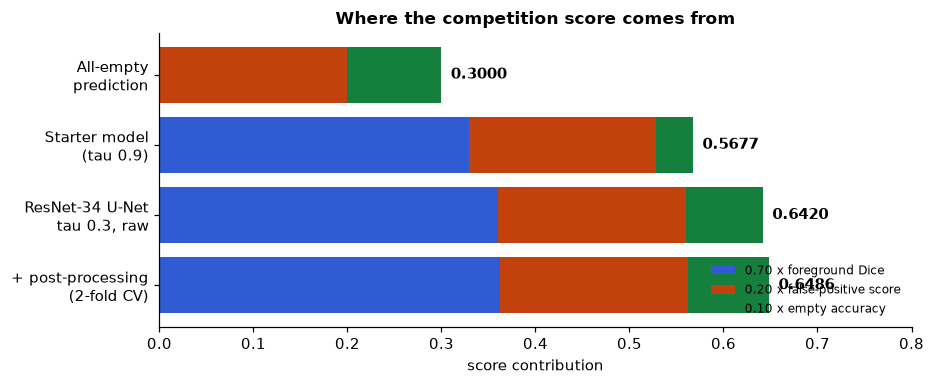
The score combines Dice overlap, a false-positive penalty, and an empty-image bonus. Predicting nothing already earns 0.30, so the weights shape every decision that follows.
- How the Dice coefficient measures mask overlap.
- How the score treats images where the right answer is "no defect".
- Why this metric rewards finding defects over staying quiet.
Dice overlap
Dice compares a predicted mask \(X\) with the true mask \(Y\):
It equals 1 when the masks match exactly and 0 when they share no pixel. The edge case is two empty masks: \(|X| = |Y| = 0\), so the fraction is 0/0. The project's code defines Dice(empty, empty) as 1, and a non-empty prediction against an empty truth as 0.
Dice painter
The outlined shape is the ground truth. Paint your own prediction on the grid by clicking and dragging; the first cell you touch decides whether you paint or erase. Then switch the ground truth to "empty" and see what happens.
The score has three parts
A model predicts four masks for every image, so the metric works on image-class pairs: 45,572 of them in the training data. Of those, 7,201 pairs have a defect and 38,371 are empty. The score is:
- ForegroundDice averages Dice over pairs that have a defect. A missed defect scores 0.
- FalsePositiveScore is 1 minus the average fraction of the image that you wrongly mark on empty pairs.
- EmptyAccuracy is the share of empty pairs where you predicted nothing at all.
This is the function in src/common.py. It also returns the naive mean Dice, where every pair counts and empty-versus-empty is 1:
def competition_score(pred_area, gt_area, inter):
    pos = gt_area > 0
    dice = np.where((pred_area + gt_area) == 0, 1.0,
                    2 * inter / np.maximum(pred_area + gt_area, 1))
    fg = dice[pos].mean() if pos.any() else 1.0
    fp = 1 - (pred_area[~pos] / N_PIX).mean() if (~pos).any() else 1.0
    ea = (pred_area[~pos] == 0).mean() if (~pos).any() else 1.0
    return {"score": 0.7 * fg + 0.2 * fp + 0.1 * ea, "fg_dice": fg,
            "fp_score": fp, "empty_acc": ea, "naive_dice": dice.mean()}
The function only needs three numbers per pair: the predicted area, the true area, and their intersection. That is why the training code can score millions of pixels with a few array operations.
A worked toy batch. The milestone analysis scores 50 pairs: 10 with a defect (6 at Dice 0.8, 4 at Dice 0.4) and 40 empty. The model stays quiet on 36 empty pairs and paints 1,024 pixels on the other 4. ForegroundDice is 0.64, FalsePositiveScore 0.999, and EmptyAccuracy 0.90. The score is 0.7378. The naive mean Dice for the same batch is 0.848.
Score calculator
Set the three ingredients and read off the score. The "All empty" preset is the model that never predicts anything.
The "Model, tau 0.3" preset uses the foreground Dice and empty accuracy from runs/r34_baseline/eval.json; the false-positive pixels are set to 0 for simplicity. The naive Dice shown is an approximation that assumes every wrong empty pair scores Dice 0.
What the weights reward
Do the arithmetic for the model that never predicts a mask. ForegroundDice is 0, FalsePositiveScore is 1, and EmptyAccuracy is 1. The score is 0.2 + 0.1 = 0.3000. Its naive mean Dice is 0.8420, which is just the fraction of empty pairs. Naive Dice makes an empty submission look strong, which is why the project tracks the official score instead.
Why the metric rewards recall
One pair with a defect is worth up to \(0.7 / 7201 \approx 9.7 \times 10^{-5}\) of the score when you segment it perfectly. One empty pair where you wrongly predict something costs at least \(0.1 / 38371 \approx 2.6 \times 10^{-6}\), plus a small amount from the false-positive pixel penalty. A missed defect is therefore about 37 times more expensive than one false alarm.
If your Dice on a true defect is about 0.5, predicting a mask pays off once the chance that the pair has a defect exceeds roughly 5%. So the best decision threshold is low, and the tuned values in lesson 6 are low (0.05 to 0.2). Naive Dice pulls the other way. It keeps improving as you raise the threshold, which lesson 6 shows.
How the score is computed in the code
Two functions in src/train.py evaluate a set of predictions. score_at turns uint8 probabilities into a mask with a single threshold, and then counts areas and intersections:
def score_at(probs_u8, masks_u8, thr):
    pred = probs_u8 >= int(round(thr * 255))
    gt = masks_u8.astype(bool)
    pa = pred.sum((2, 3)).ravel()
    ga = gt.sum((2, 3)).ravel()
    it = np.logical_and(pred, gt).sum((2, 3)).ravel()
    return competition_score(pa, ga, it)
src/evaluate.py calls score_at at thresholds 0.3, 0.5, 0.7, and 0.9 to produce the raw sweep, then runs the post-processing tuner. Probabilities are stored as bytes from 0 to 255, so a threshold of 0.3 becomes 77.
A model predicts nothing for every image and class. What is its competition score?
- 0.0000
- 0.3000
- 0.8420
ForegroundDice is 0, FalsePositiveScore is 1, and EmptyAccuracy is 1, so the score is 0.7×0 + 0.2×1 + 0.1×1 = 0.30. The value 0.8420 is its naive mean Dice.
Why does the project set a low threshold for most classes?
- Low thresholds make masks smoother.
- Low thresholds make training faster.
- A missed defect costs far more than a false alarm under this metric.
Each positive pair carries about 37 times the weight of one wrong empty pair, so a model that predicts a mask when it is even slightly unsure scores higher.